PASFIELD LAKE PROJECT
Project Overview
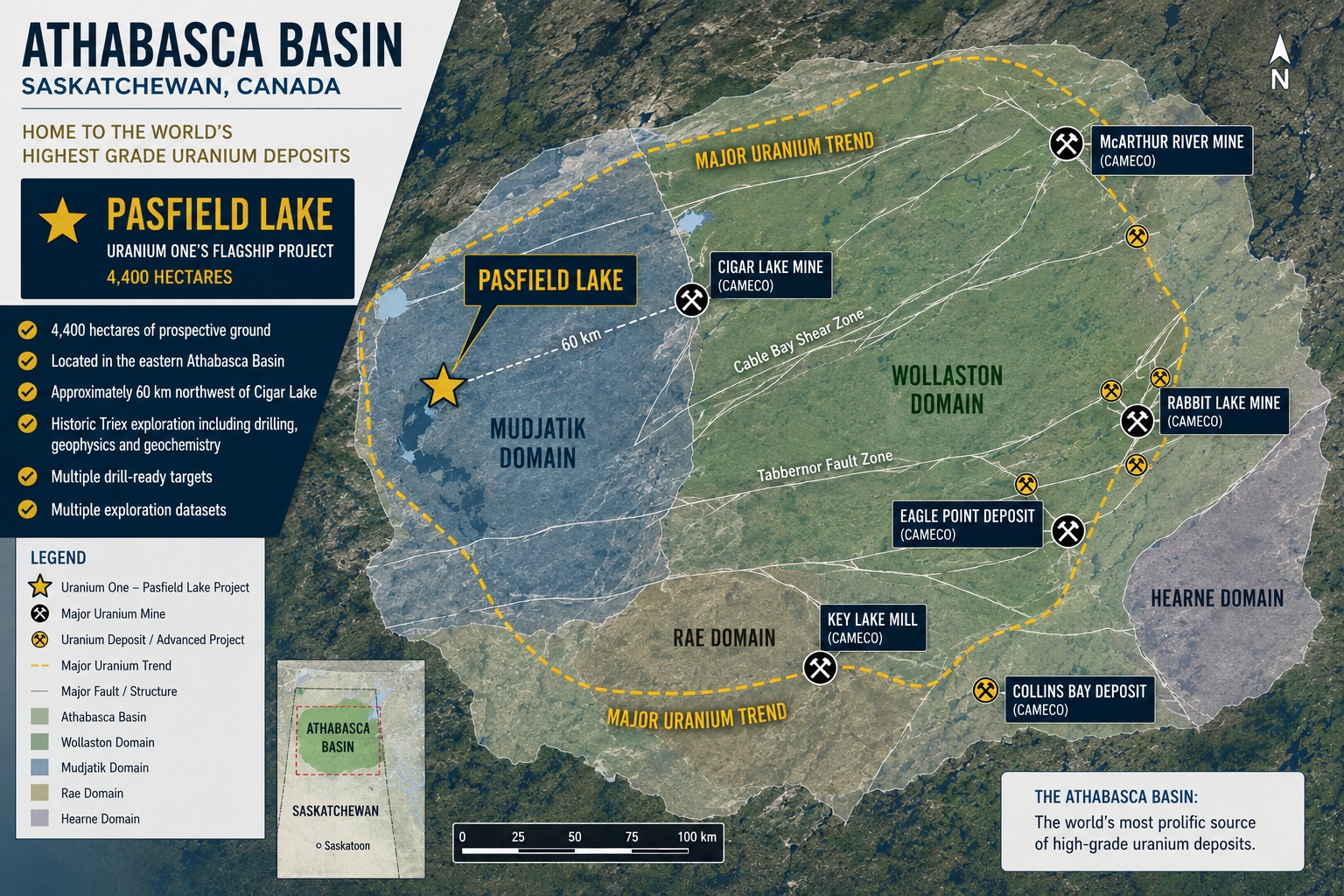
The Pasfield Lake Project is Uranium One’s flagship Canadian uranium exploration asset, encompassing approximately 4,400 hectares in Saskatchewan’s eastern Athabasca Basin, widely recognized as the world’s premier jurisdiction for high-grade uranium discoveries. Strategically located approximately 60 kilometres northwest of Cameco’s Cigar Lake Mine, the project occupies a highly prospective geological setting where favourable basement rocks, major regional fault systems, and historical exploration results combine to create an exceptional exploration opportunity.
HISTORY
Pasfield Lake has benefited from several exploration campaigns conducted by Triex Minerals and earlier operators, who recognized the property’s favourable geological setting within the Athabasca Basin. Their work focused on identifying the structural and geological conditions associated with unconformity-related uranium deposits.
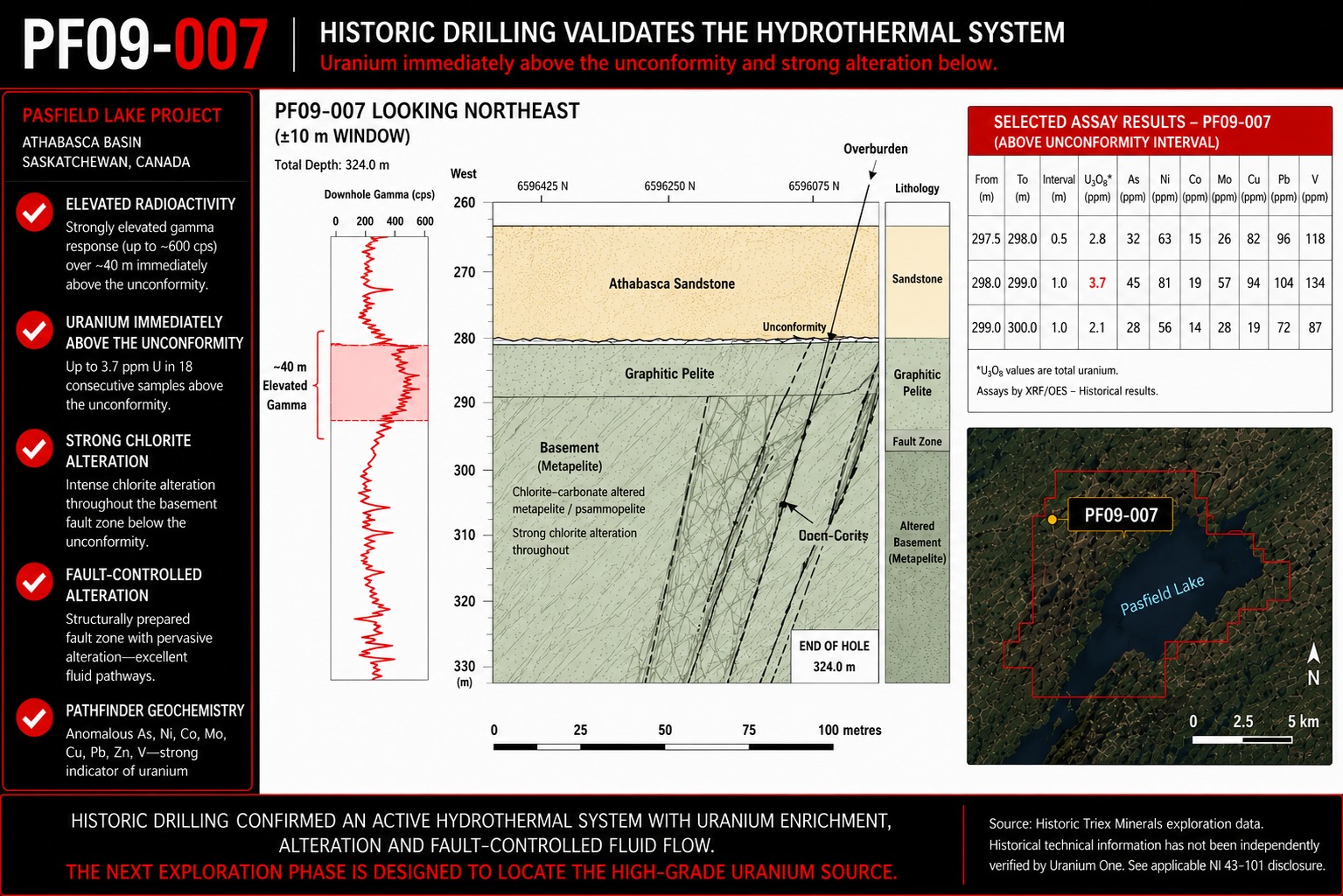
Exploration programs included regional airborne VTEM surveys, detailed gravity and magnetic surveys, Audio Magnetotelluric (AMT) surveys, geochemical sampling, and diamond drilling. Historical drilling confirmed the presence of a large hydrothermal system, intersecting chlorite alteration, structural faulting, uranium pathfinder elements, and elevated radioactivity above the unconformity—all important indicators commonly associated with major Athabasca uranium deposits.
Location & Geological Advantage
The Pasfield Lake Project is strategically located within Saskatchewan’s eastern Athabasca Basin, the world’s premier jurisdiction for high-grade uranium discoveries. The property occupies a highly favourable geological setting where several major regional structural features converge, creating the conditions commonly associated with unconformity-related uranium deposits. Historical exploration has identified multiple geological, geophysical, and structural characteristics that significantly enhance the project’s discovery potential and provide compelling targets for modern exploration.
Key geological advantages include:
- Eastern Athabasca Basin Location – Situated within one of the world's most prolific uranium districts, home to numerous high-grade uranium mines and discoveries.
- Proximity to Cigar Lake - Located approximately 60 kilometres northwest of Cameco's Cigar Lake Mine, one of the world's highest-grade uranium operations.
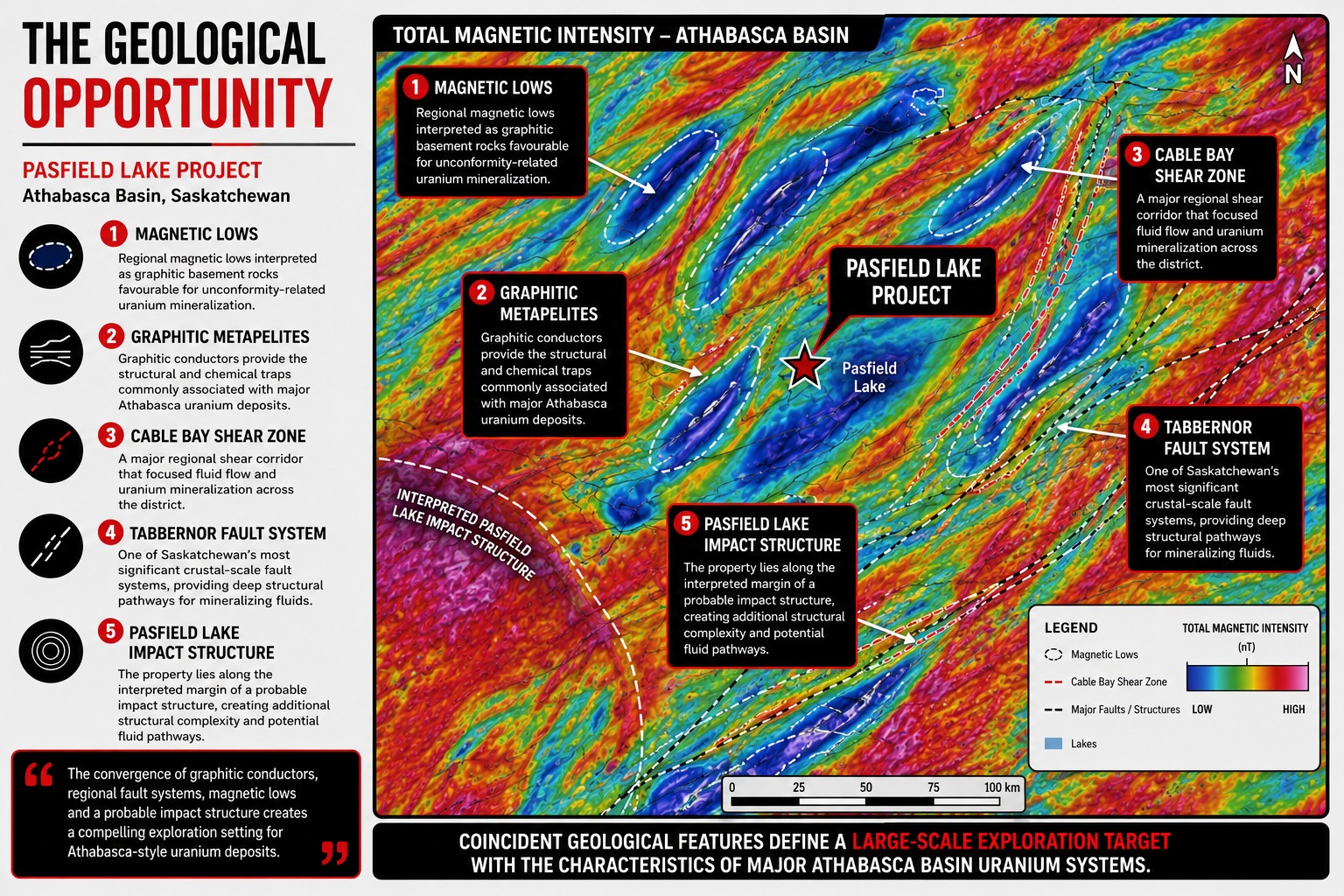
- Major Structural Corridors - The property lies near the intersection of the Cable Bay Shear Zone and the Tabbernor Fault System, two significant crustal-scale structures that may have provided pathways for uranium-bearing hydrothermal fluids.
- Graphitic Basement Conductors - The property lies near the intersection of the Cable Bay Shear Zone and the Tabbernor Fault System, two significant crustal-scale structures that may have provided pathways for uranium-bearing hydrothermal fluids.
- Multiple Geophysical Anomalies - Historical VTEM, magnetic, gravity, and Audio Magnetotelluric (AMT) surveys define several coincident conductive and structural targets that remain only partially tested.
- Impact Structure Association - The project lies along the interpreted margin of the Pasfield Lake impact structure, where increased structural complexity may have enhanced fluid movement and uranium deposition.
- Large Untested Exploration Corridor- Several kilometres of favourable structural trends remain largely unexplored using modern geological models and exploration technologies, providing substantial upside discovery potential.
Recent Work & Findings
Exploration Potential
Pasfield Lake exhibits many of the geological ingredients associated with major Athabasca Basin uranium discoveries, yet much of the property remains underexplored by modern standards. Numerous conductive corridors, structural intersections, and coincident geophysical and geochemical anomalies remain only partially tested or entirely untested by historical drilling.
Investment Highlights
Pasfield Lake represents one of Uranium One’s most compelling exploration opportunities. Located in the heart of the Athabasca Basin, the project combines a world-class geological setting with extensive historical exploration, multiple coincident exploration vectors, and numerous untested drill targets. Supported by a substantial historical technical database and enhanced by modern exploration technologies, Pasfield Lake is positioned to become a cornerstone asset within Uranium One’s growing uranium portfolio.