Projects

yuty-img

Yuty Prometeo Uranium Project

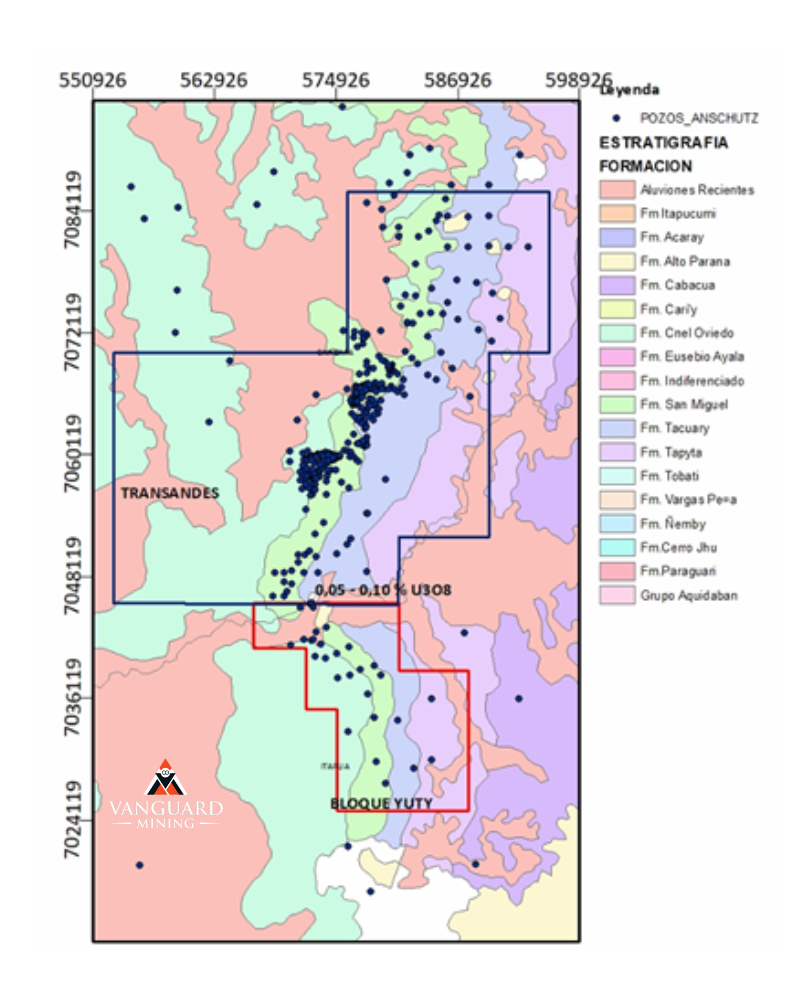
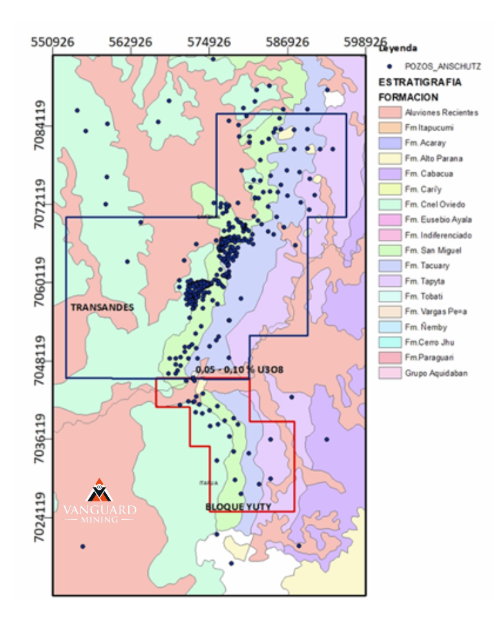
Yuty Prometeo Project Yuty Prometeo Project – Paraguay Location: Paraná Basin, Southeastern Paraguay Size: ~90,000 hectares (222,395 acres) Status: Early-stage exploration Commodities: Uranium (U₃O₈) Contiguous Operator: Uranium Energy Corp. (NYSE American: UEC) Target Formation: Upper Permian–Carboniferous Contact  Overview The Yuty Prometeo Project consists of the San Jose and Uno Concessions, together covering approximately 90,000 hectares within the highly prospective Paraná Basin in southeastern Paraguay. This project is strategically located adjacent to Uranium Energy Corp.’s (UEC) Yuty Deposit, which currently hosts an NI 43-101 compliant resource of 8.96 million pounds of U₃O₈.  The Yuty Prometeo Project leverages favorable regional geology and existing exploration data, indicating continuity with known uranium mineralization trends that extend from UEC’s nearby holdings.  Uno Concession  Area: ~27,666 hectares (68,368 acres) Contiguous to: UEC’s Yuty Project  The Uno Concession has been the focus of historical exploration, including 28 completed drill holes that returned uranium assays ranging from 0.05% to 0.10% U₃O₈. Geophysical surveys, drilling data, and surface sampling collectively suggest the Prometeo block is geologically on-trend with UEC’s adjacent Transandes Block, making it a high-priority target for follow-up exploration and resource delineation.  San Jose Concession  Area: ~62,210 hectares (153,754 acres) Location: ~100 km NW of
Read More »
pocitos-feature-img

Pocitos 1 Lithium Brine Project

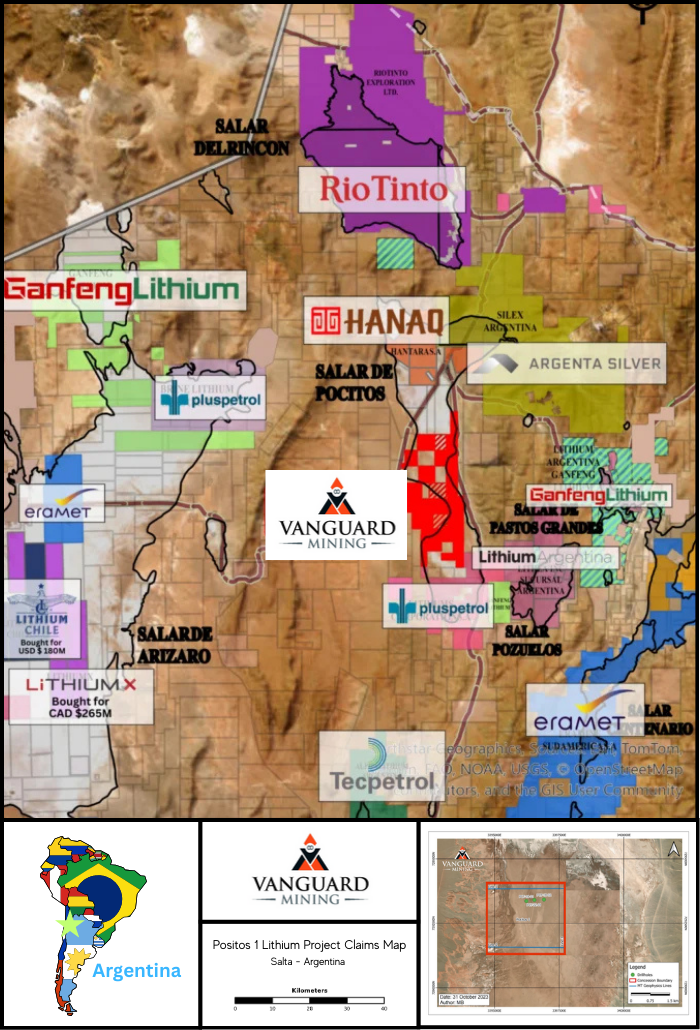
Pocitos 1 Lithium Brine Project – Salta, Argentina Location: Salar de Pocitos, Puna Plateau, Salta Province, ArgentinaSize: ~800 hectaresStatus: Advanced exploration stageCommodities: Lithium (brine)Infrastructure Proximity: Township of Pocitos (~10 km; gas, electricity, accommodation available) Overview The Pocitos 1 Lithium Brine Project is located on the Salar de Pocitos in Salta Province, within the prolific Puna Plateau—one of the most important geological settings for lithium brine deposits globally. The Puna Plateau is characterized by elevated fault-bounded blocks separated by elongated, endorheic (closed) basins that act as natural traps for fluids and host thick evaporite deposits. These closed basins, combined with a dry climate and high rates of evaporation, provide the ideal environment for the accumulation and concentration of lithium-rich brines. Surrounding mountain ranges have a north–south (meridian) orientation and their uplift, driven by block faulting, has shaped the basins and controlled sediment input. The Pocitos and Pozuelos basins are divided by the Cordón de Pozuelos, a prominent structural high composed primarily of Ordovician-age rocks that show slight metamorphism. At the base of the surrounding ranges, extensive coalescing alluvial fans funnel sediments and fluids into the salar system, playing a critical role
Read More »

Quark Uranium Project

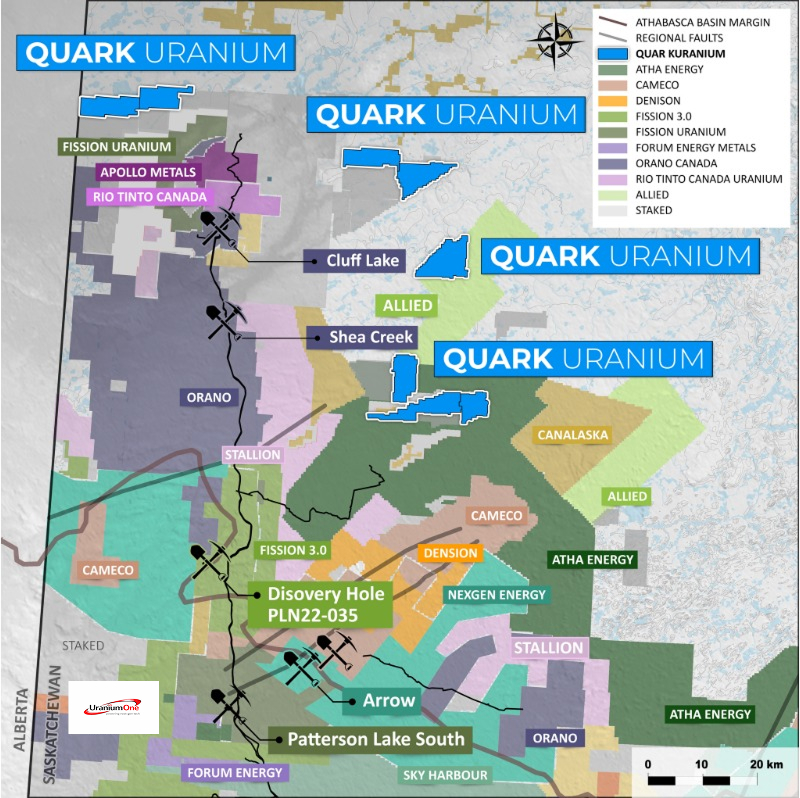
Located in the world-renowned Athabasca Basin of Saskatchewan, Canada, the Quark Uranium Project represents a strategically positioned exploration opportunity in one of the highest-grade uranium districts globally. The region has historically contributed a significant share of global uranium production and remains the premier jurisdiction for new discoveries.
The Quark Project consists of a large, contiguous land package of approximately 28,746 hectares (71,030 acres), situated within the highly prospective Western Wollaston Domain and Wollaston–Mudjatik Transition Zone—host to the majority of Canada’s past and present uranium mines.

Yuty Prometeo Uranium Project

The Yuty Prometeo Uranium Project consists of the San Jose and Uno Concessions, together covering approximately 90,000 hectares within the highly prospective Paraná Basin in southeastern Paraguay. This project is strategically located adjacent to Uranium Energy Corp.’s (UEC) Yuty Deposit, which currently hosts an NI 43-101 compliant resource of 8.96 million pounds of U₃O₈. 

The Yuty Prometeo Uranium Project leverages favorable regional geology and existing exploration data, indicating continuity with known uranium mineralization trends that extend from UEC’s nearby holdings. 

Nucleon Uranium Project

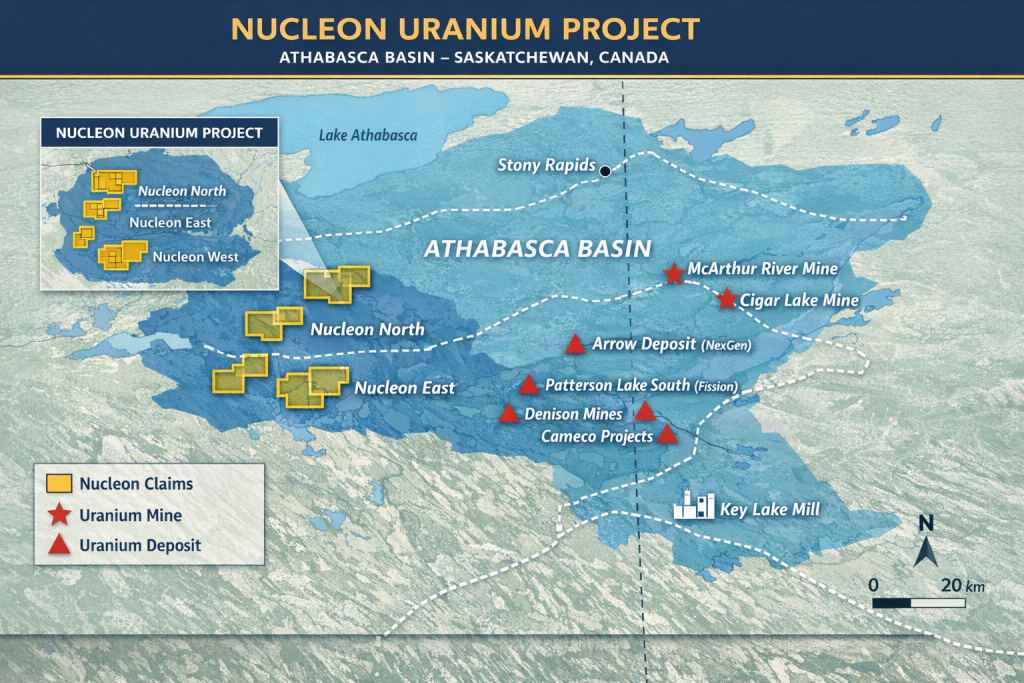
The Nucleon Uranium Project consists of seven exploration-stage mineral claims totaling approximately 23,424.90 hectares located in northern Saskatchewan, Canada, within the world-class Athabasca Basin — widely recognized as the premier uranium district globally.

The project is organized into four prospective exploration areas situated along key uranium discovery corridors in the Basin.

Brussels Creek Project

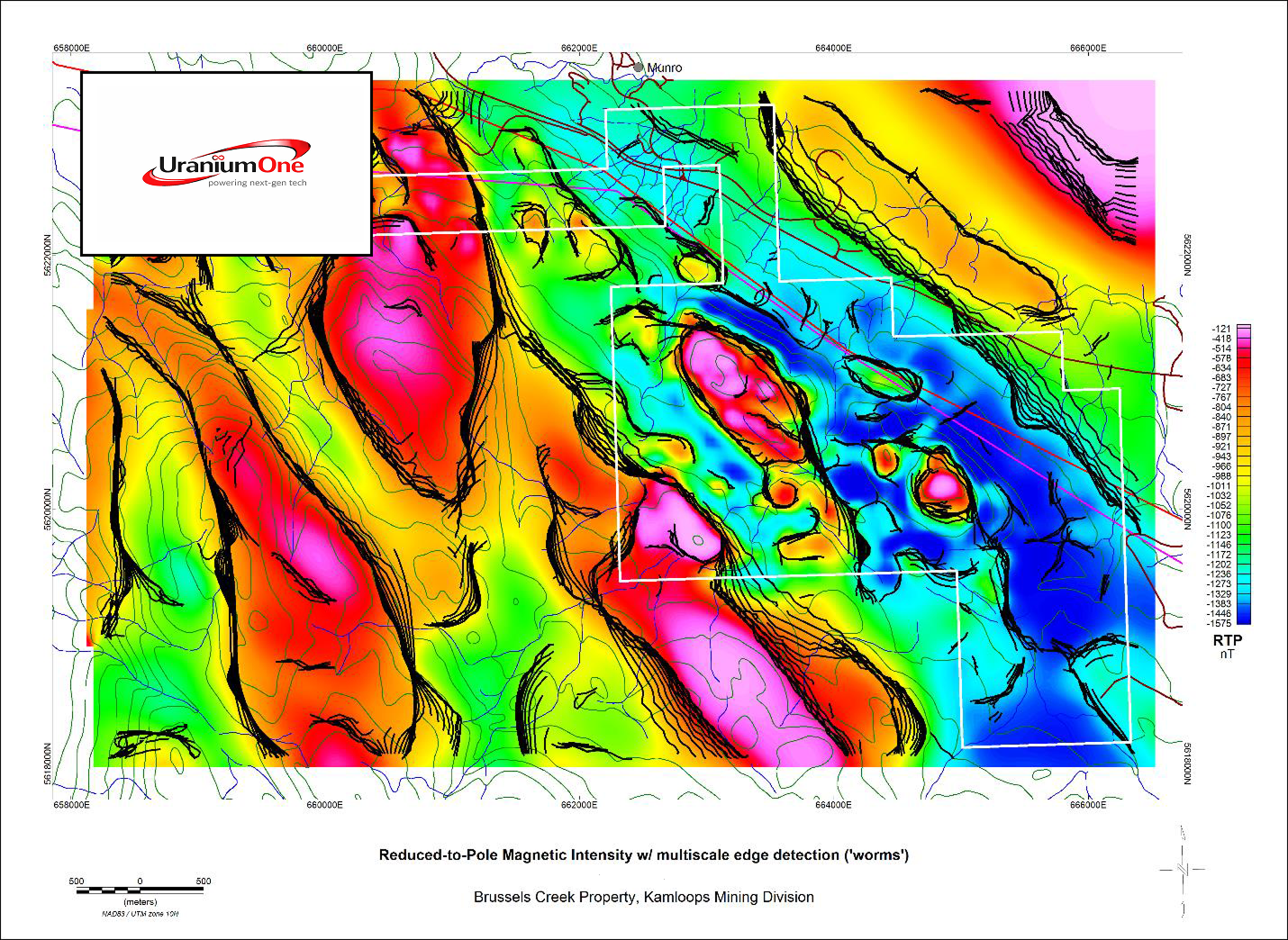
The Brussels Creek Project is an exploration stage project located in the Kamloops Mining District, British Columbia, Canada, about 24 km west of Kamloops, BC. Mineral tenure consists of 66 cells, covering approximately 13.5 km2.

The project is organized into four prospective exploration areas situated along key uranium discovery corridors in the Basin.

Pocitos 1 Lithium Brine Project

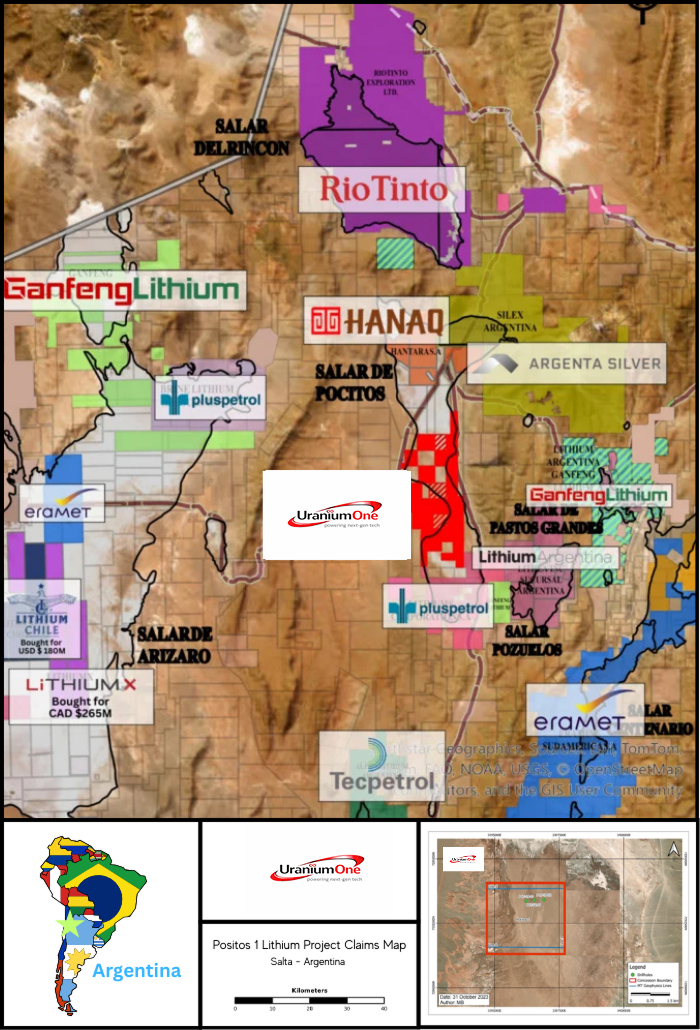
The Pocitos 1 Lithium Brine Project is located on the Salar de Pocitos in Salta Province, within the prolific Puna Plateau—one of the most important geological settings for lithium brine deposits globally.

The Puna Plateau is characterized by elevated fault-bounded blocks separated by elongated, endorheic (closed) basins that act as natural traps for fluids and host thick evaporite deposits. These closed basins, combined with a dry climate and high rates of evaporation, provide the ideal environment for the accumulation and concentration of lithium-rich brines.

Redonda Copper-Molybdenum Project

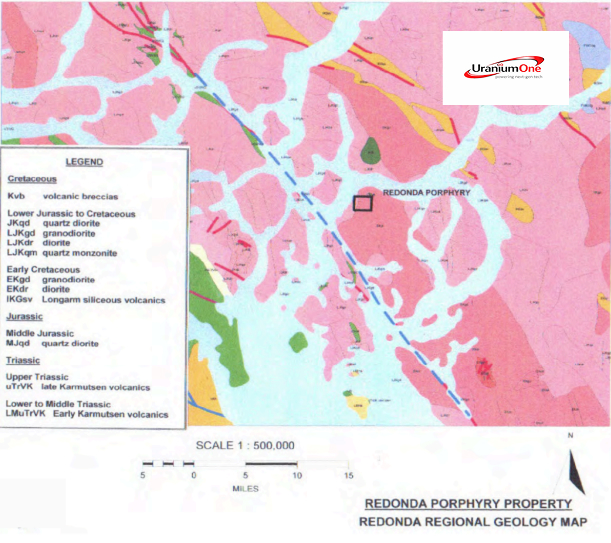
The Redonda Copper-Molybdenum Project is a premier exploration asset 100% owned by Uranium One Mining, located within the Vancouver Mining Division of British Columbia, Canada, near Campbell River. Covering approximately 2,746.46 hectares across nine mineral claims, Redonda represents a district-scale porphyry-style copper-molybdenum opportunity with strong geological potential and excellent access year-round.

The Redonda Project lies within the Coast Suture Zone, a structurally complex and highly prospective geological corridor known to host porphyry copper and skarn systems. Mineralization at Redonda is associated with dioritic to granodioritic intrusive rocks, brecciation, and widespread hydrothermal alteration.